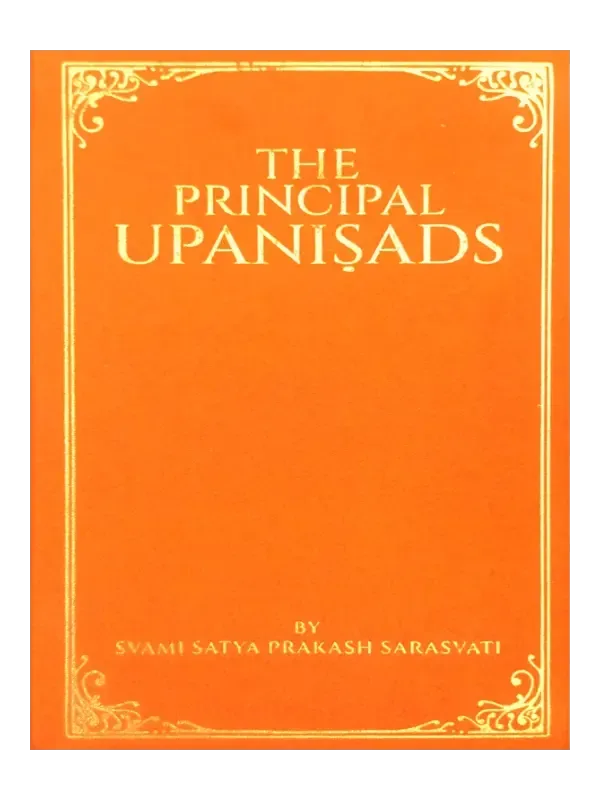
The Principal Upanisads – by Swami Satyaprakash Sarswati
Original price was: ₹600.00.₹550.00Current price is: ₹550.00.
- Author: Swami Satyaprakash Sarswati
- Language: English, Sanskrit-English
- Pages: 690
- Edition: 2022
- Cover: Hard Cover
- ISBN: 9788170773133
- Weight: 1022 Gms.
EDITORIAL
Vedas are the scripture of all true knowledge. The source or producer of this knowledge is Omniscient God. In the ‘Satapatha Brahmana rşi Yājñavalkya says to Maitreyi,
“एवं वा अरेऽस्य महतो भूतस्य निःश्वसितमेतद्यदृग्वेदो यजुर्वेदः सामवेदोऽयर्वांगिरसः ॥” [14.5.4.10]
O Maitreyi! the four Vedas-the Rgveda and others came out of God who transcends even space easily and naturally like the breath.
As the breath comes out of the body and is again taken into it, so the Vedas are revealed by God and are again withdrawn at the time of dissolution. The Vedas narrated four classes of subjects viz. Jñāna, Karma, Upāsanā and Vijñāna separately. Other Vedic literature like Brāhmaņa, Āranyaka, Upaniṣadas etc. are written to explain the true meaning of mysterious vedic hymns.
Upanisadas are also expounded to give an exposition of the Vedic hymns regarding Brahma-the Supreme God, who is the ultimate goal of everyone’s life.
The word ‘Upanisad’ has three words ‘upa’, ‘ni’ and ‘sad’. Upa and ni are prepositions and sad is the root which has three mean-ings-to sit down, to destry and to loosen. Upa means ‘near’ and ‘ni’ means down or devotedly. So, the word Upaniṣad means the setting down of the disciple near his teacher in a devoted manner to recieve instruction about the Highest Reality which loosens all doubts and destroys all ignorance of the disciple. [see ‘A critical survey of In-dian philosophy by Dr. C.D. Sharma.]
The famous western scholor F. Max Müller had given an other exposition of this word: Whenever the word (Upaniṣad) occurs, it has the meaning of doctrine, secret doctrine, or is simply used as the title of the philosophic treatises which constitute the ‘jñānakanda’ the knowledge portion, as opposed to the ‘karınakanda’, the work or ceremonial portion of the Veda.
Ācārya Sankara, who established a new theory regarding Vedānta-philosophy, brings out a new meaning of the word
Upaniṣad- ‘ब्रह्मविद्योपनिषद्…परं श्रेयोऽस्यां निषण्णमिति ॥’ [तैति. उप. 2.9] means the Upaniṣad is ‘Brahmavidyā’…… and the highest bliss is contained in the Upanisad.
On observing the importance of the Upanisadas, it is but natural that so many Indian as well as western erudite scholors set down their commentaries on them. Among Indian scholars Ācārya Sankar has been the most popular who, in writing his commentaries on the Upaniṣads, was chiefly guided by philosophical considerations, his chief object being to use the Upaniṣads as a sacred foundation for the (neo) Vedanta philosophy, may now and then have taken liberties with the text. [sacred book of the east, Vol. XV, by Max Müller].
Among vigorous western scholors, who worked upon the Upaniṣads are F. Max Müller, Pal Deussen, Schlegel, Gough, Arthur Schopenhauer etc. No doubt, schopenhauer was very fond of Upanisads. He declared that his own philosophy was powerfully impregnated by the fundamental doctrines of the Upaniṣads. Again The revealed, “In the whole world there is no study, except that of the originals, so beneficial and so elevating as that of the Upaniṣads. It has been the solace of my life, it will be the solace of my death.”
Though it is very clear and accepted by all the scholars that the original teachings i.e. the doctrine of the Upanisads are of same na-ture, but their interpretations are utterly different. Some of the expo-nents of the Upaniṣads are of the view that there is only one truth entity i.e. Supreme Lord-Brahma: other apparent entities are noth-ing but like a dream. On the other hand, there are such scholors, who obviously evince that there are three real entities-Brahma (God), Jiva (soul) and the original cause of the universe i.e. called Prakrti.
Whatever the interpretations be, it is very much conspicuous fact that the main object of the Upaniṣads is to enunciate the concept of Atman. Word Ātman indicates Jiva-ātman as well as Paramātman (Brahma); it has been cleared in Mundakopanisad (3.1.1). Again Rşi says, “आत्मा वा अरे द्रष्टव्यः श्रोतव्यो मन्तव्यो निदिध्यासितव्यो । दृष्टे
श्रुते मते विज्ञातं इदं सर्वं विदितम् ॥” [बृ. आ. उप., 4.5.6] it means verily this self (the Atman) is to be seen, to be heard, to be percieved and to be realised. O Maitreyi! when the self has been heard, percieved and realised, then all this automatically becomes known.
In this issue we are presenting Upanisads with the translation of late Svami Satya Prakash Sarasvati, who was the founder editor of this journal. As we know very well that Svamiji was a professor of science in his earlier life (in grhastha āśrama).
He concieved the fond-ness of Vedic philosophy as well as Vedic dharma from his father, a great scholar of his time named Pandit Ganga Prasad Upadhyaya. In addition to his, being a first rank scientist he was also an editor, a lexicographer, a philosopher and a freedom-fighter. He could read, write and speak on different subjects in various languages authenti-cally. Being a profound reader and a great thinker he penned a lot of books and articles on various topics. One of his extraordinary works is the translation of the four Vedas into English.
Svamiji translated nine Upaniṣads into English. Some of these are being presented in the this issue. On several verses of these Upaniṣads Svamiji’s translations were unavailable to us. For the convenience of our readers, we are giving the translations done by F. Max. Müller on these verses. Svamiji himself, quoted Max Müller on so many places for comparative analyses in these Upaniṣads.
Svamiji translated these Upanisads according to the philosophy of Svami Dayanand Sarasvati. But, being liberal and open-minded he quoted other Indian as well as western scholors of opposite thoughts, for comparative studies.
We hope that researchers as well as scholors will be be able to understand the Upanisads in their real terms, As was the wish of Svamiji also.
-Ved Prakash
Related products


Reviews
There are no reviews yet.