
Aryasamaj and Shuddhi Movement (English)
₹300.00
- Author: Dr. Vivek Arya
- Language: English
- Publication: Bharatiya Hindu Shuddhi Sabha
- Pages: 165
- Edition: 2023
- Cover: Paperback
- Weight: 170 Gms.
Preface
Shuddhi is a Sanskrit term used broadly for redemption, recla-mation and for upward mobility of a person. It is also described as a purification process encompassing reclamation of the frustrated and strayed masses and the reconversion of non-Hindus back to Vedic Dharma. Shuddhi Sanskar in simple words is a ceremony performed to bring back the lost ones.
The concept of Shuddhi originates in the Vedas while it is widely mentioned in other scriptures like Smriti Granths and other texts. There are a lot of examples of Shuddhi dur-ing the medieval period which are especially mentioned in the Puranas. This proves that Shuddhi ceremony was quite common in the past also when individuals were re-absorbed into the fold of their paren-tal religion. However, with the passage of time and especially during the advent of Islam and Christianity, the digestive power of Hindu-ism weakened and the current of river water started flowing in the opposite direction.
During this decadence period, Hindus had com-pletely forgotten the concept of Shuddhi. In large numbers they had started accepting Islam and Christianity due to various reasons. Hence, in order to bring back those persons who were either lost to Hinduism or were on the brink of joining foreign religions due to caste rigidities or other reasons, the Shuddhi movement of Arya Samaj was started. Dr. R K Ghai in his book has mainly enumerated the following reasons:
“With the decline of Buddhism, the country came under Mus-lim rule. Muslim rulers used force, persuasion, and all other means to convert non-Muslims to the Islamic folds. The main reason for the conversion to Islam was forcible conversion, war, natural calamities, massive destruction of the seats of learning, rapid decline in the Gurukula system of education, the lure of high posts, or feudatory gains, polygamy, patronage by the Muslim rulers and never to forget the proselytizing efforts by Islamic preachers, etc.
Along with them the European powers such as the French and the British also ran in the race to acquire a political base in India in order to secure their trade. This period of political instability was one of the most crucial phases in the social history of India.
Confronted with rampant immorality, tyranny, and corruption, the Indian society degenerated to such an extent that religious bigotry, superstition, ir-rational and inhuman beliefs and practices such as sati, infanticide, superstitions, animal sacrifice, and the caste system became cardinal principles of the Indian value system. Such politically divided, so-cially degenerated, and economically exploited Hindu Society steeped into ignorance. In such a dreaded situation it was a major uphill task to reform the downtrodden condition of Hindu society and restore its previous glory and status”.
The credit of reintroducing the Shuddhi movement goes to Swami Dayanand Saraswati. He decided to liberate Hindu society from this ignorance. He advocated molding and recreating a new dynamic and liberated society by demolishing the walls of separat-ism, allowing social mobility vertically, and dissolving social rigidi-ties. Under such circumstances, it was natural for Swami Dayanand to reform and consolidate Hindu society by restoring Shuddhi, a pro-cess of ritual purification to destroy the walls of hierarchical separat-ism. The focus was on inculcating good qualities in individuals to develop their physical, social and spiritual capabilities.
Swami Dayanand was well aware that for centuries a large num-ber of races of peoples of foreign origin had been continually com-ing to India before the Muslims, and were absorbed into Hinduism.
Swami Ji argued that the ancient Aryans had a tremendous zeal for Aryanizing people as they did with the Greeks, the Sakas, the Kushans, the Huns, and various others. Ancient texts like Dewala Smriti and Agni Purana refer to the existence of the institution of conversion under the name Vratyastoma, but it was with the advent of Islam the reverse process started and the conversion of the Hindus began. Gradu-ally as the caste system became rigid, there appeared an unwilling-ness to take the lost brothers back into Hinduism.
It is believed that the question of Shuddhi for the first time arose during Swami Dayanand’s visit to Punjab in 1877. In Jullundur, six months after his arrival in Punjab, he reconverted a Hindu who had become a Christian. His name was Kharak Singh, and he was born a Sikh then became a Hindu and was subsequently baptized by Rev. Robert Clark of Amritsar. He became an Arya after meeting the Swami.
One person named Ram Sharan, a Brahman of Ludhiana who was teaching in a Mission School and was about to be converted to Christianity, abandoned his idea after meeting Swami Dayanand. During 1879 in Dehradun, Swamiji reconverted a born Muslim named Muhammad Umar who was renamed as Alakhdhari. Besides these individual cases, there are a few instances that establish that any per-son could be admitted to the fold of Hinduism if he promised to lead a life according to the dictates of the Vedas.
Swami Dayanand through his speeches, impressed many probable converts to Christianity to remain within the Hindu fold and in the process stemmed the tide of Christianity. At Amritsar, about 40 Hindu students under the influ-ence of Christian propaganda had almost become unbaptized Chris-tians, who on listening to Swami Dayanand’s preaching’s changed their decision to convert to Christianity.
Taking cue from Swami Dayanand, the concept of Shuddhi was carried forward by his successors, such as, Swami Shraddhanand, Lala Lajpat Rai, Bhai Parmanand, etc., through the platform of Arya Samaj. Swami Shraddhanand carried Shuddhi of Malkans Neo Mus-lims living near Agra in thousands of numbers. He started the Shuddhi. movement on 13th February 1923 in Agra to bring back the lost broth-ers. Under his able guidance Arya Samaj made Shuddhi as a mass movement which spread in the whole country.
The Shuddhi move-ment was opposed by Muslims, Christians and even narrow minded sectarian Hindus. It led to a political storm in the country and it was opposed by political leaders of that time. Foremost among them was none other than Mahatma Gandhi. He wrote articles against Swami Shraddhanand, Arya Samaj and Shuddhi movement.
His articles worked as ammunition for Muslims who used his name to attack the movement. This provocation and propaganda lead to Hindu Muslim tensions in the country leading to riots, arson, property damage and loss of lives. In such dreadful atmosphere the heat of provocation was faced by Swami Shraddhanand leading to his martyrdom. This great sacrifice of Swamiji, added as fuel to the missionary zeal of Arya Samaji and Shuddhi movement started gaining momentum. This book tells us the story of bravery, courage and sense of sacrifice shown by the followers of Arya Samaj. This book is based on various writings, unpublished thesis, re-
search documents, journals by eminent writers and scholars like K W Jones, Gene Robert Thursby, James Reid Graham, JTF Jordens, R K Ghai, etc. These scholarly works are PhD thesis by Kenneth Will-iam Jones named “The Aryasamaj in the Punjab: A study of social reform and religious revivalism, 1877-1902 published from Univer-sity of California in 1966, PhD thesis by Gene Robert Thursby named Aspects of Hindu-Muslim relations in British India.
A study of Aryasamaj activities, government of India policies and communal conflict in the period 1923-1928 published from Duke university in 1972, PhD thesis by James Reid Graham named The Aryasamaj as a reformation in Hinduism with special reference to caste published from Yale university in 1942, Book by JTF Jordens named Swami Shraddhanand: his life and causes published from Oxford University press in 1981, PhD by R K Ghai named Shuddhi Movement in India A Study of Its Socio-political Dimensions published from Common-wealth Publishers in 1991.
This book is basically a compilation of all their laborious writings. It is being published on the occasion of the centenary year of Bhartiya Hindu Shuddhi Sabha. The objective for publication of this book is to enlighten the readers with the glorious history of Shuddhi movement. Shuddhi is a unique movement – a feather in the cap of Arya Samaj which in spite of strong opposition and resistance from the adversaries has made a mark. As a sentinel of Hinduism, it is a memorable chapter written in the history of Arya Samaj.
As a Compiler of this work, I am thankful to Shri Subhash Dua for his valuable inputs and support in publishing this book on behalf of Bhartiya Hindu Shuddhi Sabha.
Dr. Vivek Arya
Related products
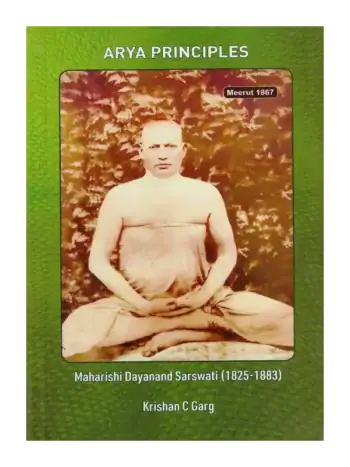
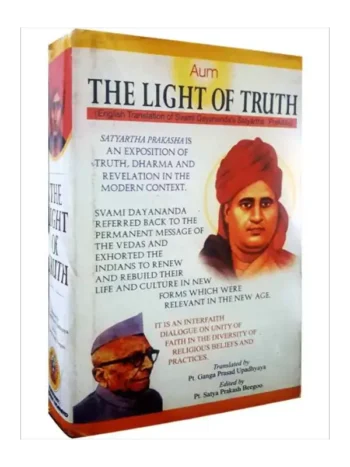
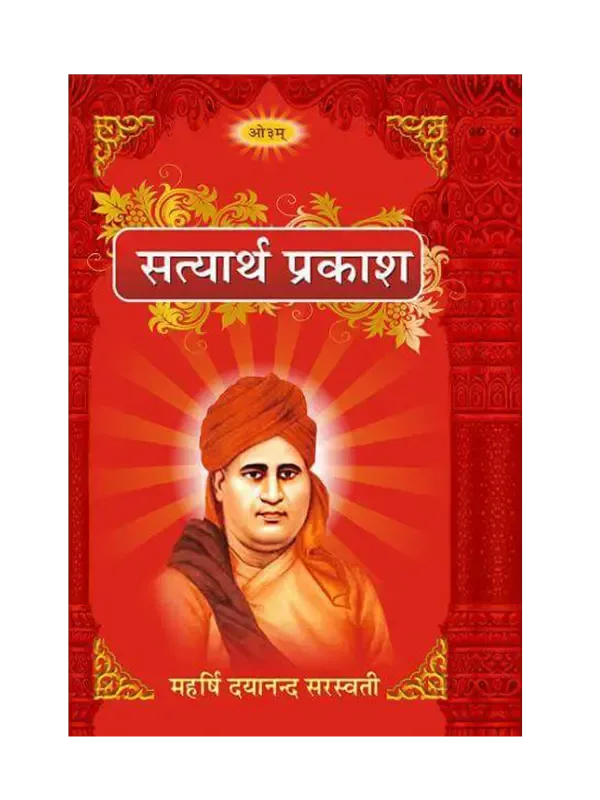
The Light Of Truth – by Swami Dayanand Sarswati
Original price was: ₹525.00.₹500.00Current price is: ₹500.00.
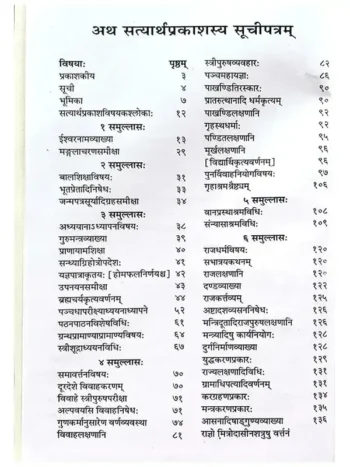
आर्य समाज का इतिहास (डॉ. सत्यदेवनिगमालंकार चतुर्वेदी) Arya samaj Ka Itihas – by Dr. Satyadev Nigamalankar Chaturvedi
Original price was: ₹7,500.00.₹7,000.00Current price is: ₹7,000.00.
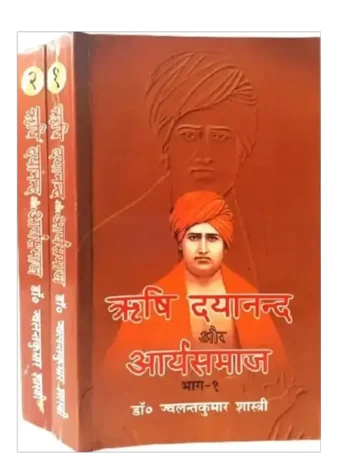
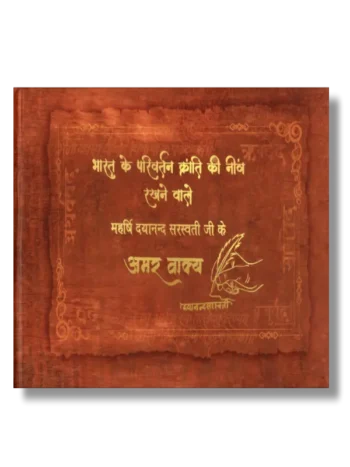
महर्षि दयानन्द के अमर वाक्य Maharshi Dayanand k Amar Vakya
Original price was: ₹2,000.00.₹750.00Current price is: ₹750.00.
Reviews
There are no reviews yet.