Preface
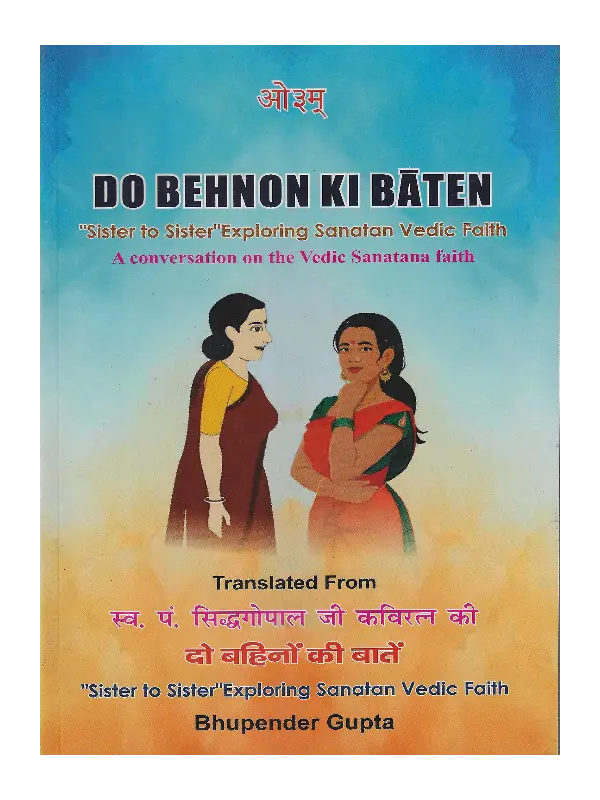
“Do Behnon ki Bäten – A conversation on the Vedic sanatana faith” is an English version of the renowned book, “Do Behnon Ki Baaten,” written by late, Shri Pandit Siddhagopal (Kaviratan) Ji. Both of these works are presented as a conversation between two cousin sisters on many intriguing and popular topics that support the Vedic sanatana dharma. Unfortunately, and sadly for all of us, a biographical sketch of the original author, Shri Pandit Siddhagopal (Kaviratan) Ji, is not present in the Hindi edition.
However, when one reads this book and experiences how clearly the principles of the dharma have been laid out in the quick and easy to grasp lucid vernacular one cannot help but conclude that he was an unusually gifted scholar of the Shrutis. Many complex and subtle Vedic faith related topics are covered and laid out in easy-to-understand style for all who are curious and open minded to grasp and benefit from.
The importance of the original Hindi version and the current English edition also lie in the fact that the questions raised by the younger cousin cover the common thought processes that occurl in modern day life for Hindu or non-Hindu, theistic in outlook or otherwise, and formally educated or not. The responses given by the older sister are impressively rational and intellectually accessible.
I got involved in the writing of the English version of the work when the then President of the Arya Pratinidhi Sabha America, Shri Vishrut Arya Ji, approached me and suggested that I consider doing it. However, knowing the difficulty involved in doing full justice to translating any specific subjective work, leave aside the one so deeply spiritual in scope as is the ‘Do Behnon ki Baaten’,
I had initially hesitated, but then, on second thoughts, realizing the gap it will close by making the material available to the non-Hindi educated minds, I accepted it. As translator and editor, I sincerely feel that I have done my best and succeeded greatly in capturing and effectively conveying the thoughts of the original author. Still, I continue to regard the original work invaluable and suggest that a reader consider it if language is not an issue.
Some worth mentioning features of the translated English book are as follows:
1. The new book has 14 chapters, instead of the 12 as in the Hindi book. This is because two of the chapters in the original book, in my view, covered somewhat less related and more independent topics. Therefore, the text of each of these has been split into two chapters, making the English edition having 14 chapters.
2. Although the material of each of the chapters emphasizes a different topic area, it still covers several different aspects of the subject, which, for better understanding and cross referencing, were considered important to be identified and labeled. Therefore, the material in each chapter has been divided into sections, each headed by a descriptive title.
3. It was noted that often a given section itself touched on more than one teaching or concept, which was also believed to be worth highlighting. This is accomplished by adding subtitles within sections, where needed.
4. Additionally, the editor had felt that most readers will find it valuable if a summary of the subject matter was provided for each topic covered. Accordingly, at the end of each chapter, an overview of the points and the teachings emphasized in it has been added.
5. Furthermore, in one case, i.e. Chapter 13, titled “On meat as food for human consumption,” the scope of the material has been augmented by including some more recently learnt facts based on well published and highly regarded research.
As usually is the case when translating a faith based Hindi/Sanskrit text into English, one encounters words that do not have ideal equivalent terms in English. Either the English words do not have the same depths or nuances of some of the Hindi/Sanskrit terminology or, worse, the language does not even have the concepts present in the Hindu faith.
Some examples of these are sukba, dukha, yagya, yajnya, jnána, dev, upasana, etc. In such cases, the original words have been retained and expressed in italics, and the applicable English sense of these have been included in parentheses. (In transliterating the Hindi/Sanskrit words into English, the only special character used is ‘a’ which is pronounced as does a in words such as father, after, etc.) An alphabetical listing of the Hindi/Sanskrit words used, along with the meaning (s), is included in Part II of the book.
An additional issue one faces when writing a book on dharma in English, as in many other languages, is to settle on the question of what pronouns would be most appropriate for use in the sentences when one is referring to the Divine Being, who is genderless: He, She, Him, Her, It? The two decided to be used throughout this book are ‘(S)He’ and ‘It’.
References for other highly regarded and relevant publications are provided for consulting and further reading in Part II. Also given in the same part is a cross-index for the concepts and teachings considered important and covered in the book.
In closing, I am privileged to have undertaken the task of translating this uniquely relevant Vedic Dharma based title into English. I express my heartfelt thanks to the leaders of the Arya Pratinidhi Sabha America, in particular, Shri Bhuvnesh Khosla Ji, the President, and Shri Vishrut Arya Ji, the former President and currently the General Secretary, for urging me to undertake this project for the benefit of our Arya community.
Their trust and confidence in my ability to complete this important treatise is greatly appreciated. In the course of carrying out this project, I have made full use of the suggestions provided by several scholar friends. One of these, deserving special mention, is Shri Vidyadhar Garg ji, whose insightful thoughts have been particularly useful and which I have used liberally in many places of the book. I sincerely thank all these associates for their valuable contribution to the success of this work. And, lastly, and sincerely, the writer thanks his wife, Mrs. Vasudha Gupta, for making herself available to lend support as and when needed and for being a wonderful partner for him.
Bhupender S. Gupta
The Hindu Society of North Carolina
Morrisville, NC 27560, USA


Reviews
There are no reviews yet.